
The Drift Log · Model independence and repeatable builds
Rebuilding Last Quarter Artifacts from Tagged Commits
27 October 2026 · 3 min read · 727 words · established
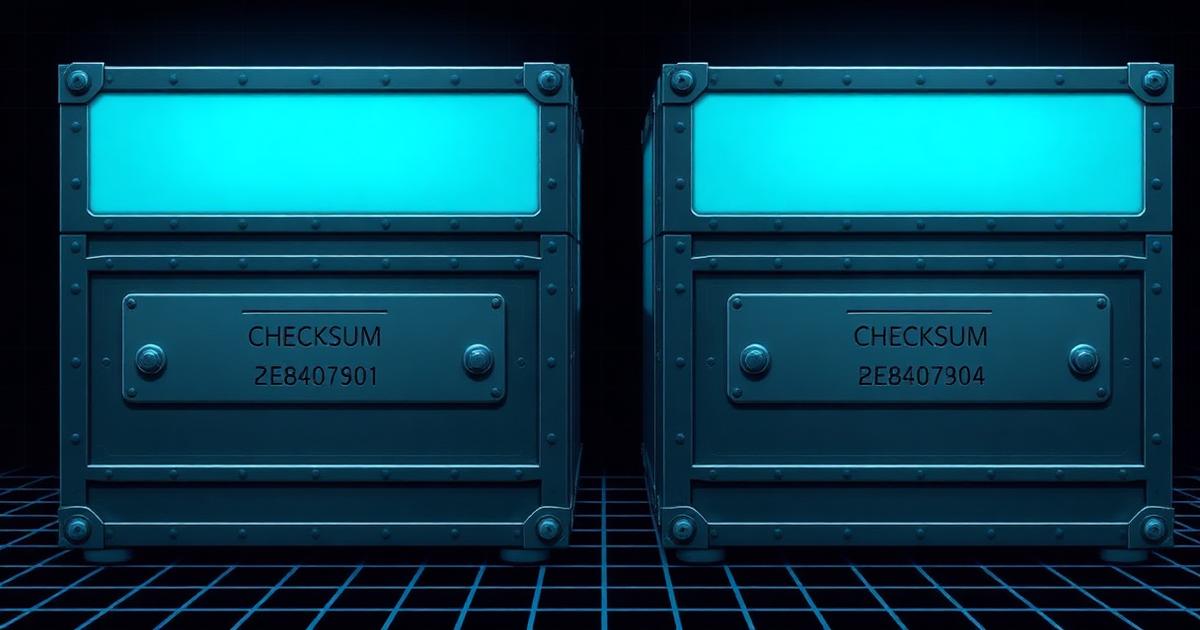
Git tags pin source code, not build environments. Here is how toolchain drift and metadata leaks break byte-for-byte artifact reproducibility.
You check out git tag v2.4.0 from ninety days ago. You run the build script. The command succeeds, exits with code zero, and produces a binary.
Then you run sha256sum against the new binary and compare it to the release hash logged in production. They do not match.
You have the exact commit that produced the release. Yet you cannot reproduce the release. If an auditor asks for evidence, or a critical zero-day requires a backport patch against that specific build graph, you are debugging an artifact you cannot reconstruct.
A git tag only pins source code. Source code is only one argument in the function that produces your software.
The Ambient Leaks in Your Build Graph
When a build is not repeatable, the failure almost always stems from ambient state leaking into the compiler. Three variables cause most hash drift over a quarter:
- Floating Toolchains. Running
go buildorcargo buildagainst a tag uses whatever compiler happens to be installed on the worker. A patch release of a compiler can change register allocation, optimization passes, or default metadata embedding. The source is identical; the machine code is not. - Network Egress During Compilation. If your build step fetches packages without strict, cryptographic content-addressing (or resolves dynamic dependency ranges), the registry will eventually serve different bytes. Even package lockfiles often allow metadata updates or platform-dependent script execution. We have covered the necessity of hermetic environments in our look at eliminating external service calls.
- Environment Timestamps and Paths. Compilers frequently embed file modification times, local absolute paths, and the current system time into artifact headers. Without setting SOURCE_DATE_EPOCH overrides, two builds run five seconds apart on identical hardware will yield distinct release artifacts.
Software that relies on dynamic inputs during its build step or incorporates runtime model responses inherits unbounded variance. As we argued in why model independence is an engineering posture, if your logic cannot be audited and pinned to immutable inputs, you do not own the execution path—you merely rent an unpredictable snapshot.
The Pure Build Function
Achieving reproducible builds requires treating compilation as a pure, mathematical function:
$$\text{Artifact} = f(\text{Source}, \text{Toolchain}, \text{Environment})$$
If any parameter varies, the output diverges. To lock down the output bytes:
- Pin the toolchain precisely. Use content-hashed container environments or hermetic build systems like Nix or Bazel. A build should declare the exact cryptographic hash of the compiler, linker, and standard library it uses.
- Sever network access. The build phase should execute in an isolated network namespace. All dependencies must be pre-fetched, validated against a cryptographic manifest, and vendored or mounted read-only before compilation begins.
- Normalize metadata. Strip local paths from debug symbols (using flags like
-fdebug-prefix-map), clamp file timestamps to the git commit epoch, and sort file inputs deterministically before passing them to archive tools liketarorzip.
Deterministic software requires strict control over the build environment. When these inputs are pinned, recording build checksums provides genuine verification rather than a transient record of a single CI run.
How SHPBL Handles Verification
SHPBL ships software capability designed for strict reproducibility. The code in our engineered catalog is model-independent: no machine-learning models run inside it, and no component behaviour depends on an external model's output at runtime. The logic is computed, static, and owned outright.
We publish the SHA-256 build checksums for our release archives directly in our root of trust. When you run an artifact through our certification harness, the verdict confirms whether the build matches its published contract byte-for-byte. We do not claim an artifact is certified unless it passes this exact gauntlet under fixed conditions.
What to Check on Monday
Pick a release tag from six months ago. Provision a clean virtual machine or container that does not have your local shell history or cached dependencies.
Clone the repository at that tag, run your documented build instructions, and calculate the SHA-256 hash of the generated artifact.
If the hash does not match your historical release record:
- Diff the file listings and headers inside the artifact using
diffoscope. - Check for timestamp drift in archive metadata.
- Disable internet access in your CI build container to identify undocumented network fetches.
Fixing these leaks turns your git tags from approximations into exact, restorable states.
Keep reading
Next in the log
- Isolating Async Task Schedulers for Repeatable Builds
Eliminate build archive hash mismatches across heterogeneous CI runners by replacing ambient async task resolution with invariant-ordered queues.
- Eliminate Clock Drift in Distributed Test Suites with a Virtual Time Provider
Inject a virtual‑time provider to replace system clocks and eliminate flaky tests caused by clock drift in distributed suites.
- Source-Date-EPOCH Overrides for Reproducible Builds
Fix timestamp variance in CI by setting SOURCE_DATE_EPOCH to ensure byte-for-byte reproducible archives.
The Strategic Master Library · written and reviewed under the house's own epistemic rules: nothing claimed that we cannot show.