Source-level
ENG-040 / BLD-ENG-040
Semantic encoding → deterministic normalization and tagging
Proprietary system · v0.5.0
The Multiverse Compiler
If a solution disappears, can another world invent it again?
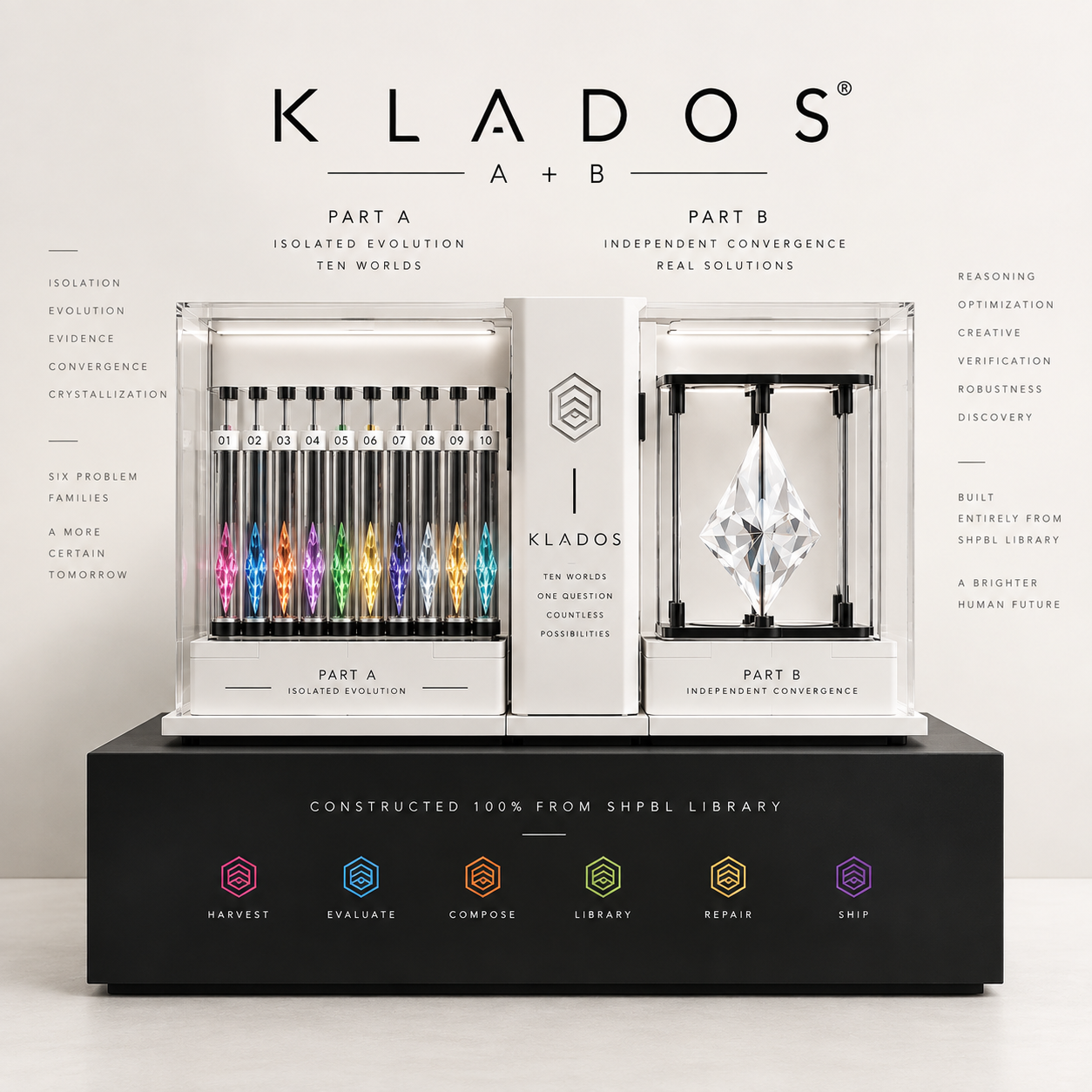
KLADOS runs isolated software worlds against the same testable problem. Most candidates fail. Independent convergence is stronger evidence than one successful mutation.
Enter the ObservatoryFirst principles
Describe
State a registered, testable problem in bounded English.
Seal
KLADOS compiles the exact problem and execution contract.
Approve
A human reviews that contract before any experiment begins.
Evolve
Ten isolated worlds search, fail, preserve evidence, and sometimes converge.
Replay
A candidate must survive exact replay and independent-support controls.
Stage
A second approval may stage it. The Governor still decides whether it enters SHPBL.
Live model · canonical proof scale
Each rail begins separately. Branches may mutate, fail, leave fossils, or independently approach the same behavior. Similarity is not enough: ancestry and exposure still matter.
Core multiverse proof · sealed v0.5.0
2 qualified candidates
Independence controls
KLADOS examines starting capability distance, founder-genome distance, seed distance, pollination exposure, and ancestry. Branch worlds and pollinated worlds cannot support an independent-rediscovery claim.
An Independence Score describes the declared relationship among supporting worlds under the sealed experiment contract. It is evidence inside that experiment—not a universal quality score.
Bounded deterministic English
“Find a better capability composition using demo-benchmark with ten worlds and about 10000 candidates, with no cross-pollination.”
The compiler may compile, clarify, or refuse.
It recognizes only registered families, datasets, oracles, quantities, comparisons, units, and constraints. Ambiguity and contradiction fail before approval. It does not claim general English understanding.
Capability Composition
Binary Detector Synthesis
Policy Optimization
Workflow Optimization
Algorithm Composition
Regression Repair
Provenance
SHPBL did not paste a library into KLADOS. It specialized useful capability behavior, replaced nondeterministic identities, and retained the relationship as evidence. Source-level parents contributed inspected implementation behavior; contract-level parents contributed enforced boundaries.
Source-level
Semantic encoding → deterministic normalization and tagging
Source-level
Intent classification → bounded rule classification with evidence
Source-level
Intent disambiguation → deterministic clarification and refusal
Source-level
Intent compiler → structured intent with content-derived identity
Contract-level
Capability Contract Guardian → fail-closed registered-contract validation
Contract-level
Intent-to-Capability Compiler → deterministic execution-plan boundary
Public provenance exposes IDs, names, origin, ancestry type, specialization relationship, and evidence seals—not private bodies, harvested source, executable grammar rules, private genomes, or reconstructive implementation detail.
Before execution
ProblemSpec, compiler, catalog fingerprint, genome operator, oracle, isolation mode, and ExperimentConfig are sealed before approval. Change any bound part and approval is invalid.
Exact v0.5 verification receipt
Core multiverse
Native-language problem
Count correction: the v0.5.0 package prose states 15,712 evidence events for this run. The sealed artifact contains 15,710, and that ledger is bound by the replay seal below — recomputing the stored run seal over the sealed ledger reproduces 767338a2…, while a 15,712-event ledger hashes to a different seal. 15,710 is the canonical, seal-attested count; the higher figure is prose drift in the package documentation, not an engine result. A later production run of the same contract reproduced 15,710 independently.
Core replay seal
3e2a96f911e6dda35fcf8446d9a602e60efecc978c12f989a7a6325bad6d51f9Problem replay seal
767338a2e20d547ec87e82d0bd7d6aa545f3ae64330d14960e6489db89908562Private release ZIP SHA-256
a5fc91ca260824645fb2338dfdc3f8f2074f0308b34a431447b2229a0da590a9focused tests passing
packaged checksums verified
final staged state
Native Clade
The bounded language compiler and deterministic contract path run without an LLM, remote parser, or CMPSBL DECODE installation.
Assisted Clade
An assisted path may use external interpretation before KLADOS, but its origin and boundary must remain explicit. It is not the native proof.
What KLADOS is not
It is not a general-purpose English system, a proof that every candidate is useful, a public compute service, or an autonomous path into the SHPBL library. JavaScript cleanup is not cryptographic RAM zeroization. Human approval is required before execution and again before staging; the Governor remains the final boundary.
The fossil record
KLADOS is proprietary software. Copyright © 2026 Kenneth E. Sweet Jr. All rights reserved. KLADOS source is not publicly licensed or distributed.