
The Drift Log · Model independence and repeatable builds
Sealed Checksums for Deterministic Artifact Reproduction
7 October 2026 · 3 min read · 618 words · established
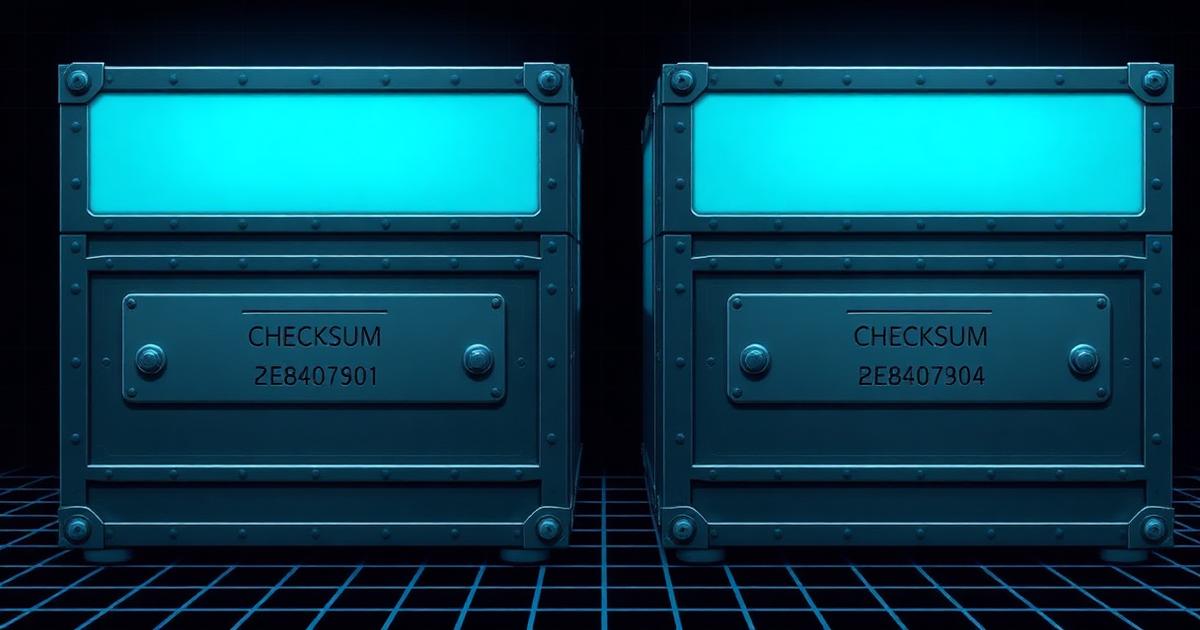
Sealed checksums let you verify that a rebuilt artifact matches the original byte‑for‑byte.
The failure to rebuild last quarter’s artifact
A team checks out the tag that shipped six months ago. The source compiles, but the binary differs from the one stored in the release archive. The diff is a few bytes in a bundled resource. The team cannot prove which version is correct. The build is not reproducible.
The root cause is a missing integrity anchor. Without a published hash of the exact archive, the rebuild is a guess. The process is fragile: compiler updates, environment drift, or non‑deterministic libraries introduce variance. The result is a “works‑on‑my‑machine” artifact that cannot be verified against the original.
Sealed checksums as a root of trust
A sealed checksum is a hash that is published alongside the archive and signed by the release authority. It is immutable: the checksum file never changes after publication. When the archive is downloaded, the consumer recomputes the hash and compares it to the sealed value. If they match, the artifact is byte‑for‑byte identical to the one that passed the certification harness.
Because the checksum is computed, not generated, it is model‑independent. No external model influences the result. The hash is a repeatable artifact of the build process itself. The checksum therefore becomes the single source of truth for artifact verification.
Embedding checksum verification in a CI pipeline
A typical pipeline can enforce reproducible builds with three concrete steps.
- Build the artifact in a hermetic environment. Use pinned compiler versions, deterministic time providers, and static primitives for any external data. The companion post “Building Hermetic Release Archives from Historical Git Tags” shows how to freeze the source tree.
- Compute the sealed checksum immediately after the build. The checksum is written to a file named
artifact.sha256. Example in a shell script:
## Build step already produced dist/my-lib.tgz
sha256sum dist/my-lib.tgz > dist/artifact.sha256- Validate against the published checksum before publishing. The validation script fetches the sealed checksum from the release server (or the root‑of‑trust page) and aborts if the values differ:
curl -sSf https://example.com/releases/v1.2.3/artifact.sha256 -o expected.sha256
diff -u expected.sha256 dist/artifact.sha256 || {
  echo "Checksum mismatch – aborting release"
  exit 1
}
If the check passes, the artifact proceeds to the certification harness. The harness records a verdict of CERTIFIED or PROVISIONAL. A mismatch results in FAILED, signalling that the build is not reproducible.
Because the checksum is sealed, the verification step removes any uncertainty about the artifact’s provenance. Teams can now rebuild a historic tag, run the same checksum comparison, and be confident that the resulting binary matches the original release. This eliminates the “cannot reproduce last quarter’s build” pain point.
How SHPBL solves deterministic artifact reproduction
SHPBL provides a library of reusable software capabilities that are model‑independent and computed rather than generated. Every release archive is published with a sealed checksum on the root of trust page. The same checksum is used by the certification harness, which records a verdict for each artifact.
When you need to verify a historic build, download the archive and its sealed checksum, recompute the hash, and compare. The process is identical whether you use the HTTP API, the TypeScript SDK, or the offline file‑based edition. The method works without any runtime model calls, keeping the software deterministic.
Start by running a free repository evaluation on a recent tag. The evaluation will surface any non‑deterministic steps and show you the sealed checksum you need for future verification.
Take the following action on Monday: pick a recent release tag, fetch its archive and the accompanying artifact.sha256 from the root‑of‑trust page, recompute the hash locally, and confirm they match. If they do not, trace the build steps for nondeterministic behaviour and apply the fixes described in the related posts, such as “Injecting Deterministic Time Providers into Async Libraries”. This simple check turns a vague reproducibility claim into a concrete, repeatable guarantee.
Keep reading
Next in the log
- Deterministic Network Mocks to Eliminate Flaky Integration Tests
Deterministic network mocks turn flaky integration tests into reproducible CI runs.
- Seeding Randomness Across Distributed Test Workers
Synchronize a single seed across CI workers to eliminate flaky tests caused by unsynchronized randomness.
- Injecting Deterministic Time Providers into Async Libraries
Inject a deterministic TimeSource to replace system clocks and make async tests reliably repeatable.
The Strategic Master Library · written and reviewed under the house's own epistemic rules: nothing claimed that we cannot show.