
The Drift Log · Model independence and repeatable builds
Sanitising Build Environments to Guarantee Bit-Identical Binaries
29 October 2026 · 3 min read · 743 words · established
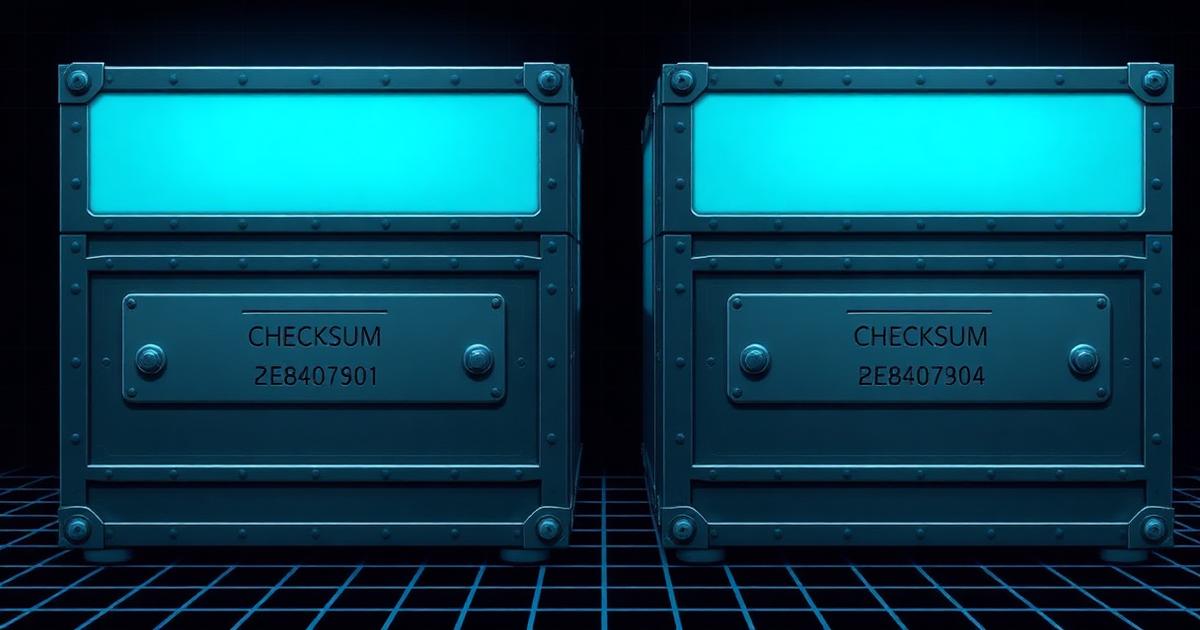
Eliminate byte variance in release artifacts by stripping ambient host locale, umask, directory read order, and embedded debug paths.
You pull a tagged release from six months ago, check out the commit, and run the packaging script. The build finishes without errors. You compute the SHA-256 of the resulting tarball or binary, and it does not match the artifact running in production.
The source code did not change. The dependencies did not change. The toolchain version matches the lockfile. Yet checksum validation fails.
When teams fail at rebuilding last quarter artifacts from tagged commits, they usually blame external package registries or minor compiler revisions. In practice, the primary culprit is ambient host state leaking into the artifact. A compiler or archiver captures whatever the host operating system feeds it: directory read order, file ownership, default umasks, host architecture tags, and locale collation sequences.
If you want reproducible builds, you cannot just freeze your dependencies. You must strip the host environment down to a sterile baseline before invocation.
Where Host Leaks Occur
Compilers and packaging tools treat ambient operating system properties as neutral context. They are not neutral; they are inputs.
Host State (Locale, Inodes, Umask, User ID)
         │
         ▼
┌──────────────────┐
│ Build Toolchain  │ ──► Byte-Variant Output (Different SHA-256)
└──────────────────┘
Three variables corrupt artifacts most frequently:
- Filesystem Traversal Order. The POSIX
readdir()system call returns directory entries in whatever order the underlying filesystem stores them in its inode tables. If your asset packager, bundler, or compiler expands a glob pattern likesrc/**/*.cor traverses a directory tree without an explicit sort, the binary or archive embeds those files in arbitrary order. An ext4 filesystem on Linux and an APFS volume on macOS will pack identical trees into completely different byte layouts. - Locale and Collation (
LC_ALL). If your build script sorts file paths or string tables to prevent the traversal bug above, the standardsortutility still respects the host locale. On a machine set toen_US.UTF-8, sorting handles punctuation, case, and Unicode collation differently than on a machine set toC. A toolchain sorting a manifest on an engineer's laptop will produce a different stream than the same toolchain running on a minimal CI runner. - Permissions, User IDs, and Timestamps. Archival formats (
tar,zip,ar) record POSIX metadata by default: modification times, numeric user IDs (uid), group IDs (gid), and permission bits determined by the hostumask. If developer A builds with aumaskof0002and developer B builds with0022, the resulting archives have different hashes, even if the file contents inside are identical.
Establishing an Isolated Execution Boundary
Guaranteeing byte-for-byte fidelity requires an explicit sanitisation pass before the build tool executes. Do not rely on developers or CI agents to have identical shell configurations. Clean the process environment completely.
A robust invocation boundary strips existing environment variables, enforces standard collation, overrides file modes, and enforces deterministic sorting into archivers:
#!/usr/bin/env bash
set -euo pipefail

## 1. Wipe the ambient environment and export strict invariants
export LC_ALL=C
export TZ=UTC
export SOURCE_DATE_EPOCH="${SOURCE_DATE_EPOCH:-$(git log -1 --pretty=%ct)}"
umask 0022

## 2. Package with normalised metadata and sorted file inputs
find dist -mindepth 1 -print0 | \
  LC_ALL=C sort -z | \
  tar --null -T - \
      --create \
      --format=gnu \
      --owner=0 --group=0 --numeric-owner \
      --mtime="@${SOURCE_DATE_EPOCH}" \
      --mode='go=rX,u+rw,a-s' \
      --file=release-artifact.tar
This pattern isolates the archive from the host machine. The LC_ALL=C setting guarantees standard ASCII byte-value sorting. Setting --owner=0 and --group=0 strips individual developer identifiers. Clamping modification timestamps to the commit date prevents the current system clock from altering archive checksums across subsequent runs.
For compiled languages like C, C++, or Rust, you must also eliminate host paths embedded in debug symbols. Flags such as -ffile-prefix-map=$(PWD)=. or Rust's --remap-path-prefix ensure that the directory path where a developer cloned the repository does not leak into the binary's .debug_info sections.
Why This Matters for the Supply Chain
Treating build inputs as strictly bounded data is the foundation of repeatable software packaging. In any secure software supply chain, you must be able to verify that a compiled binary came precisely from a specific source commit without trusting the specific machine that compiled it.
When release pipelines allow host variables to bleed into outputs, verification collapses. Teams end up accepting "close enough" builds or trusting unsigned CI runners because they cannot independently verify the binaries against published records. At SHPBL, every release archive is pinned against our published root of trust. The checksum holds whether the archive is built on an engineer's workstation, in an isolated CI container, or years later during an audit.
This discipline mirrors our broader architectural choices. As we explain in our doctrine on why model independence is an engineering posture, allowing ambient host state into a build creates the same liability as allowing opaque model outputs into runtime execution: you forfeit auditability. When software is model-independent and computed rather than generated, you own the code outright and eliminate unpredictable behaviour at the source.
Keep reading
Next in the log
- Eliminating Async Execution Jitter in Concurrency Tests
Replace sleep calls and timer guesses in async integration tests with step barriers, injected virtual clocks, and predicate latches.
- Rebuilding Last Quarter Artifacts from Tagged Commits
Git tags pin source code, not build environments. Here is how toolchain drift and metadata leaks break byte-for-byte artifact reproducibility.
- Isolating Async Task Schedulers for Repeatable Builds
Eliminate build archive hash mismatches across heterogeneous CI runners by replacing ambient async task resolution with invariant-ordered queues.
The Strategic Master Library · written and reviewed under the house's own epistemic rules: nothing claimed that we cannot show.